
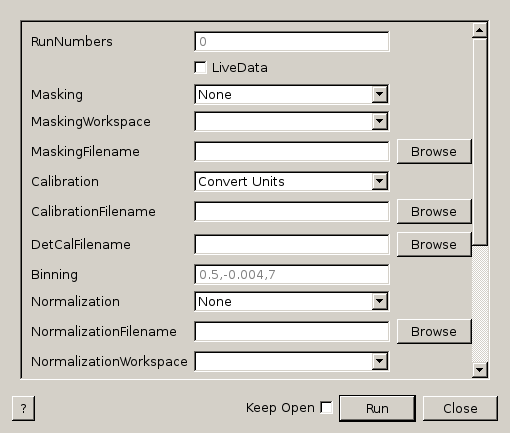
SNAPReduce dialog.
Table of Contents
| Name | Direction | Type | Default | Description |
|---|---|---|---|---|
| RunNumbers | Input | int list | 0 | Run numbers to process, comma separated |
| LiveData | Input | boolean | False | Read live data - requires a saved run in the current IPTS with the same Instrument configuration as the live run |
| Masking | Input | string | None | Mask to be applied to the data. Allowed values: [‘None’, ‘Horizontal’, ‘Vertical’, ‘Masking Workspace’, ‘Custom - xml masking file’] |
| MaskingWorkspace | Input | Workspace | The workspace containing the mask. | |
| MaskingFilename | Input | string | The file containing the xml mask. | |
| Calibration | Input | string | Convert Units | The type of conversion to d_spacing to be used. Allowed values: [‘Convert Units’, ‘Calibration File’, ‘DetCal File’] |
| CalibrationFilename | Input | string | The calibration file to convert to d_spacing. | |
| DetCalFilename | Input | list of str lists | ISAW DetCal file. Allowed extensions: [‘.detcal’] | |
| Binning | Input | dbl list | 0.5,-0.004,7 | Min, Step, and Max of d-space bins. Logarithmic binning is used if Step is negative. |
| Normalization | Input | string | None | If needed what type of input to use as normalization, Extracted from Data uses a background determination that is peak independent.This implemantation can be tested in algorithm SNAP Peak Clipping Background. Allowed values: [‘None’, ‘From Workspace’, ‘From Processed Nexus’, ‘Extracted from Data’] |
| NormalizationFilename | Input | string | The file containing the processed nexus for normalization. | |
| NormalizationWorkspace | Input | Workspace | The workspace containing the normalization data. | |
| PeakClippingWindowSize | Input | number | 10 | Read live data - requires a saved run in the current IPTS with the same Instrumnet configuration |
| SmoothingRange | Input | number | 10 | Read live data - requires a saved run in the current IPTS with the same Instrumnet configuration |
| GroupDetectorsBy | Input | string | All | Detector groups to use for future focussing: All detectors as one group, Groups (East,West for SNAP), Columns for SNAP, detector banks. Allowed values: [‘All’, ‘Column’, ‘Banks’, ‘Modules’, ‘2_4 Grouping’] |
| ProcessingMode | Input | string | Production | Set-Up Mode is used for establishing correct parameters. Production Mode only Normalized workspace is kept for each run. Allowed values: [‘Set-Up’, ‘Production’] |
| OptionalPrefix | Input | string | Optional Prefix to be added to workspaces and output filenames | |
| SaveData | Input | boolean | False | Save data in the following formats: Ascii- d-spacing ,Nexus Processed,GSAS and Fullprof |
| OutputDirectory | Input | string | Default value is proposal shared directory |
The purpose of this algorithm is to do a full reduction of SNAP data. This allows several runs, and with all the typical options that are usually used at the beamline, including calibrate from a cal file and from Convert Units, mask from file workspace and default masks, several groupings and save in GSAS or Fullprof format.
Categories: Algorithms | Diffraction\Reduction
Python: SNAPReduce.py