
This fitting function models the dynamics structure factor of a particle undergoing discrete jumps on N-sites evenly distributed in a circle. The particle can only jump to neighboring sites. This is the most common type of discrete rotational diffusion in a circle.
Markov model for jumps between neighboring sites:
![\frac{d}{dt} p_j(t) = \frac{1}{\tau} [p_{j-1}(t) -2 p_j(t) + p_{j+1}(t)]](../_images/math/16f76033401e46030060e0347366e56726baa2e7.png)
The Decay fitting parameter  is the inverse of the
transition rate. This, along with the circle radius
is the inverse of the
transition rate. This, along with the circle radius  , conform
the two fundamental fitting parameters of the structure factor
, conform
the two fundamental fitting parameters of the structure factor
 :
:


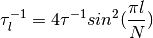
The transition rate, expressed in units of energy is  ,
with h = 4.135665616 meV ps.
,
with h = 4.135665616 meV ps.
This function is a composite of ElasticDiffRotDiscreteCircle and InelasticDiffRotDiscreteCircle.
When using DiffRotDiscreteCircle, the value of Q can be obtained either though the Q attribute or can be calculated from the input workspace using the WorkspaceIndex property. The value calculated using the workspace is used whenever the Q attribute is empty.
Methyl Rotations can be modelled setting N=3. In this case, the inelastic part reduces to a single Lorentzian:

If, alternatively, one models these dynamics using the Lorentzian function provided in Mantid:

Then:


| Name | Type | Default | Description |
|---|---|---|---|
| N | |||
| NumDeriv | |||
| Q |
 (integer, default=3) number of sites -
 (boolean, default=true) carry out numerical derivative -
 (double, default=0.5) Momentum transfer
.. properties:
(double, default=0.5) Momentum transfer
.. properties:
.. categories::