
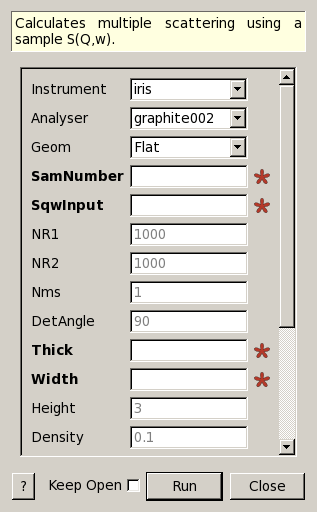
MuscatData dialog.
Table of Contents
| Name | Direction | Type | Default | Description |
|---|---|---|---|---|
| Instrument | Input | string | iris | Instrument. Allowed values: [‘irs’, ‘iris’, ‘osi’, ‘osiris’] |
| Analyser | Input | string | graphite002 | Allowed values: [‘graphite002’, ‘graphite004’] |
| Geom | Input | string | Flat | Sample geometry. Allowed values: [‘Flat’, ‘Cyl’] |
| SamNumber | Input | string | Mandatory | Sample data run number |
| SqwInput | Input | string | Mandatory | Sqw file run number |
| NR1 | Input | number | 1000 | MonteCarlo neutrons NR1. Default=1000 |
| NR2 | Input | number | 1000 | MonteCarlo neutrons NR2. Default=1000 |
| Nms | Input | number | 1 | Number of scatterings. Default=1 |
| DetAngle | Input | number | 90 | Detector angle. Default=90.0 |
| Thick | Input | string | Mandatory | Sample thickness |
| Width | Input | string | Mandatory | Sample width |
| Height | Input | number | 3 | Sample height. Default=3.0 |
| Density | Input | number | 0.1 | Sample number density. Default=0.1 |
| SigScat | Input | number | 5 | Scattering cross-section. Default=5.0 |
| SigAbs | Input | number | 0.1 | Absorption cross-section. Default=0.1 |
| Temperature | Input | number | 300 | Sample temperature (K). Default=300.0 |
| Plot | Input | string | None | Allowed values: [‘None’, ‘Totals’, ‘Scat1’, ‘All’] |
| Verbose | Input | boolean | True | Switch Verbose Off/On |
| Save | Input | boolean | False | Switch Save result to nxs file Off/On |
Calculates Multiple Scattering based on the Monte Carlo program MINUS.
It takes a sample  from an input sqw workspace and
supports both Flat and Cylindrical geometries. More information on the
multiple scattering can be procedure can be found in the modes
manual.
from an input sqw workspace and
supports both Flat and Cylindrical geometries. More information on the
multiple scattering can be procedure can be found in the modes
manual.
Example - a basic example using MuscatData.
def createSampleWorkspace(name, random=False):
        """ Creates a sample workspace with a single lorentzian that looks like IRIS data"""
        import os
        function = "name=Lorentzian,Amplitude=8,PeakCentre=5,FWHM=0.7"
        ws = CreateSampleWorkspace("Histogram", Function="User Defined", UserDefinedFunction=function, XUnit="DeltaE", Random=True, XMin=0, XMax=10, BinWidth=0.01)
        ws = CropWorkspace(ws, StartWorkspaceIndex=0, EndWorkspaceIndex=9)
        ws = ScaleX(ws, -5, "Add")
        ws = ScaleX(ws, 0.1, "Multiply")

        #load instrument and instrument parameters
        LoadInstrument(ws, InstrumentName='IRIS')
        path = os.path.join(config['instrumentDefinition.directory'], 'IRIS_graphite_002_Parameters.xml')
        LoadParameterFile(ws, Filename=path)
        ws = RenameWorkspace(ws, OutputWorkspace=name)
        return ws


ws = createSampleWorkspace("irs26173_graphite002_red", random=True)
sqw = SofQW(ws, QAxisBinning='2,1,10', Emode='Indirect', OutputWorkspace="irs26173_graphite002_sqw")
SaveNexus(ws, "irs26173_graphite002_red.nxs")
SaveNexus(sqw, "irs26173_graphite002_sqw.nxs")

MuscatData(SamNumber='26173', SqwInput='26173', Thick='0.5', Width='0.5', Instrument='irs')
Categories: Algorithms | Workflow\MIDAS
Python: MuscatData.py