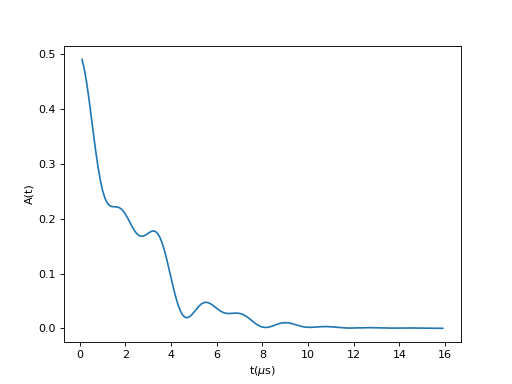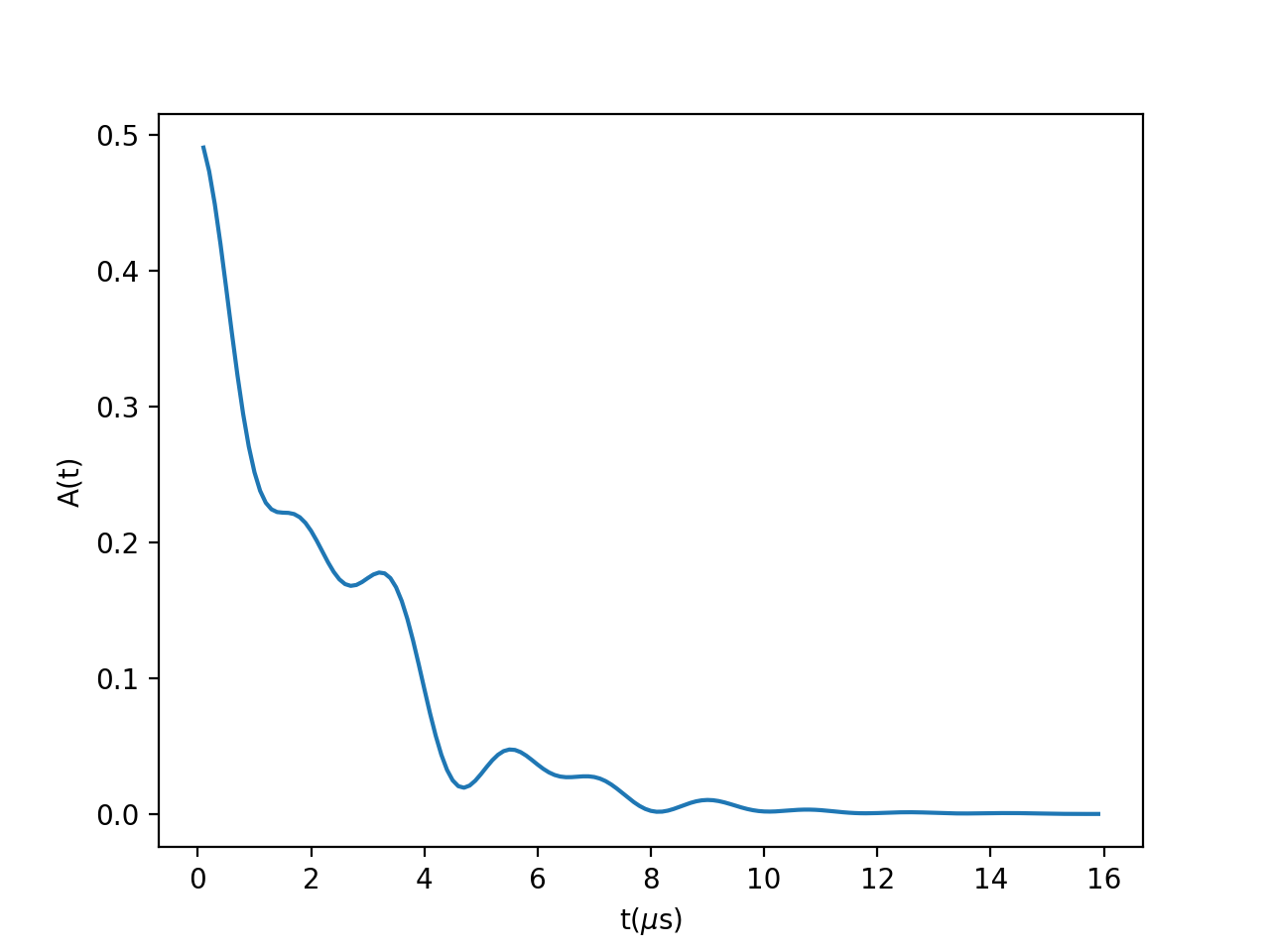
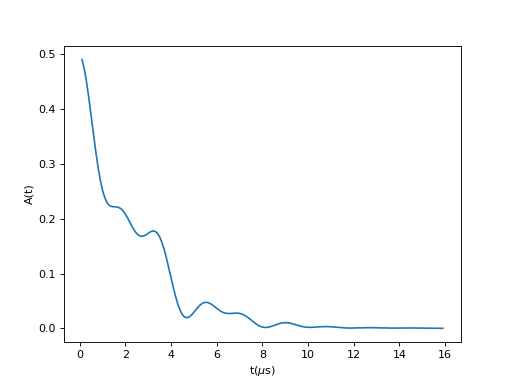
Time dependence of the polarization function for a static muon interacting with nuclear spin [1].
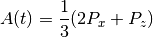
,where
![P_z(t) = \frac{1}{2J+1}\left\{1+\sum^J_{m=-J+1}[\cos^2(2\alpha_m)+\sin^2(2\alpha_m)\cos(\lambda^+_m-\lambda^-_m)t]\right\},](../../_images/math/ca87a2ce78b8dd64d57a315af15350625dedf912.png)

![\lambda_m^\pm = \frac{1}{2}[\omega_Q(2m^2-2m+1)+\omega_D\pm W_m],](../../_images/math/a01f09cc125428fc7e7e80ecd8a5d76ca461bb74.png)
![W_m = \{(\omega_D+\omega_Q)^2(2m-1)^2+\omega_D^2[J(J+1)-m(m-1)]\}^\frac{1}{2},](../../_images/math/08cf07c3e228b9587fbf6a3510084589b154c354.png)
![tan(2\alpha_m)=\frac{\omega_D[J(J+1)-m(m-1)]^\frac{1}{2}}{(1-2m)(\omega_D+\omega_Q)},](../../_images/math/1a0870866e2c6c4297e5cabecf74ee0c627a36fc.png)
 is the angular frequency due to dipolar coupling,
 is the angular frequency due to quadrupole interaction of the nuclear spin
  due to a field gradient exerted by the presence of the muon,
is the total angular momentum quantum number,
and  is the z-component of the total orbital quantum number.
(Source code, png, hires.png, pdf)
| Name | Default | Description |
|---|---|---|
| A0 | 0.5 | Amplitude |
| FreqD | 0.01 | Frequency due to dipolar coupling (MHz) |
| FreqQ | 0.05 | Frequency due to quadrupole interaction of the nuclear spin (MHz) |
| Spin | 3.5 | J, Total angular momentum quanutm number |
| Sigma | 0.2 | Gaussian decay rate |
| Lambda | 0.1 | Exponential decay rate |
Categories: FitFunctions | Muon\MuonSpecific